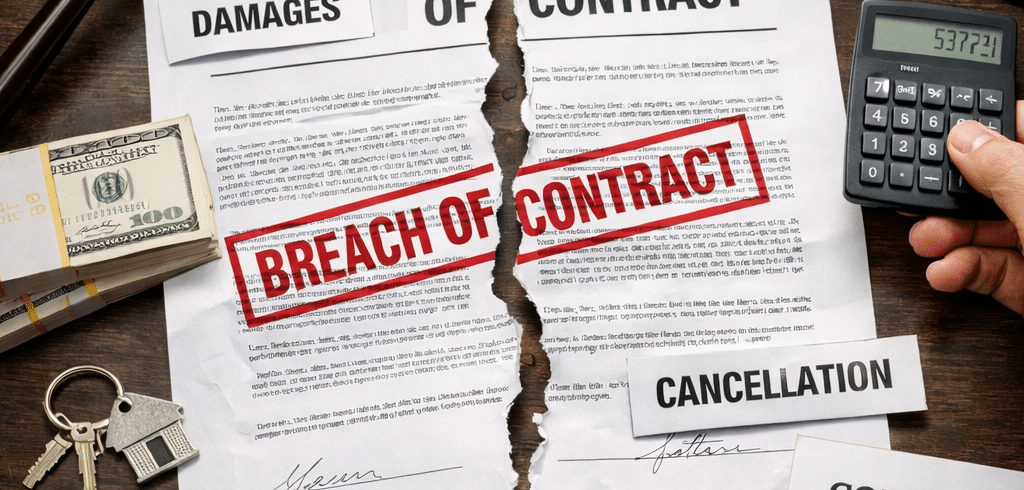
Breach of contract disputes are among the most common civil claims in Ontario. Most cases come down to a few practical questions: What did the contract require? What actually happened? Can you prove it? What losses followed? And what’s the safest next step?
Table of contents
- What is breach of contract?
- Common breach of contract examples
- Elements of a breach of contract claim
- Material vs fundamental breach
- Repudiation and anticipatory breach
- Does breach void the contract?
- Notice of breach and cure periods
- Practical next steps
- FAQ
What is a breach of contract?
A breach of contract occurs when a party fails to do what the agreement requires (or does something the agreement prohibits). In Ontario, breach of contract is typically handled as a civil dispute meaning the usual outcomes involve money (damages) or (in limited cases) court orders.
Common breach of contract examples
- Non-payment: invoices not paid, deposits withheld, missed payment dates.
- Failure to perform: services not delivered, goods not supplied, milestones missed.
- Deficient work: work delivered but below contractual standard.
- Delay: deadlines missed where timing is central to the bargain.
- Refusal to proceed: a party says they won’t perform (repudiation/anticipatory breach issues).
Elements of a breach of contract claim in Ontario
Most claims (and defences) can be organized around these elements:
1) A contract existed
Written contracts are easiest to prove, but contracts can be oral or formed through emails/quotes/invoices if essential terms were agreed.
2) You performed (or were ready and willing to perform)
Many defences to breach of contract claims in Ontario focus on whether the claimant performed their own obligations or whether performance was prevented by the other party.
3) The other party breached
Proved through the contract terms plus documents showing what happened: payment records, delivery proof, deficiency notices, emails/texts, timelines.
4) Loss caused by the breach (and mitigation)
Even with a clear breach, recovery can be reduced if losses are poorly documented or if reasonable steps to reduce losses weren’t taken. There are various remedies and damages for breach of contract in Ontario.
Material vs fundamental breach
People search “material” or “fundamental” breach because they want to know whether they can terminate. In practice, outcomes usually depend on the contract wording and whether the breach goes to the core of the bargain.
Repudiation and anticipatory breach
Repudiation/anticipatory breach in Ontario issues arise when a party signals (by words or conduct) that they won’t perform. Your response matters: terminating too early can create risk; waiting too long can reduce leverage.
Does breach void the contract?
A breach does not automatically void a contract. Termination usually depends on the termination clause (including notice/cure steps), the seriousness of the breach, and repudiation principles.
Notice of breach and cure periods
Many agreements require notice of breach and allow time to fix the problem (“cure”). Missing notice requirements can weaken your position and create termination risk.
Practical next steps
- Gather documents: contract, amendments, invoices, proof of performance, key communications.
- Build a timeline: what was promised, what happened, and when.
- Hire a Breach of Contract Lawyer. An experienced lawyer can help you prove your case and guide you in documents to collect, risk mitigation and help maximize recovery.
- Draft a damages summary: amounts owing, replacement costs, quotes, receipts.
- Preserve mitigation evidence: steps taken to reduce losses.
- Choose the right path: demand letter, negotiation, Small Claims, or Superior Court.
FAQ
Is breach of contract civil or criminal in Ontario?
Generally civil. Most contract disputes are resolved through damages (money) or, in limited cases, court orders like injunctions or specific performance.
Do I need a written contract to sue?
Not always. But written agreements and consistent emails/records usually make proof significantly easier.
Does a breach automatically let me terminate?
No. Termination depends on the contract terms, notice/cure requirements, and how serious the breach is in context.
What is a material breach?
In practical terms, a breach serious enough to affect the core purpose of the contract. The contract wording and facts usually control.
What should I do first if a contract is breached?
Preserve documents, build a timeline, calculate losses, and consider whether a demand letter or early negotiation is the best first step.
Contact McMackin Law
Have a contract dispute in Ontario?” We can assess strengths, defences, timing, and the best next step. Tell us what happened, what outcome you want (payment, performance, termination, or defence), and any deadlines. If you have the contract and key emails/texts, mention that in your message.
Tip: For faster review, include the contract date, the other party’s name, the amount in dispute, and a brief timeline (3–6 bullet points).
This page is for general information only and does not create a solicitor-client relationship. Contract disputes are fact-specific. If you have a limitation period or urgent deadline, seek legal advice promptly.